
Why Imaging Often Misses the Real Cause of Knee Pain
Knee pain often sends people down a familiar path.
First come the X-rays.
Then the MRI.
Then the report filled with phrases like degeneration, wear and tear, or arthritis.
And yet, many people walk away from those images more confused than helped.
Not because imaging is useless — but because knee pain is often not a structural problem to begin with.
What Imaging Is Good At — and What It Isn’t
X-rays and MRIs are excellent tools for identifying:
Fractures
Tears
Severe degeneration
Structural abnormalities
What they don’t measure is how well the body is:
Coordinating movement
Distributing force
Adapting neurologically
Pain does not always arise from damage.
Very often, it arises from compensation.
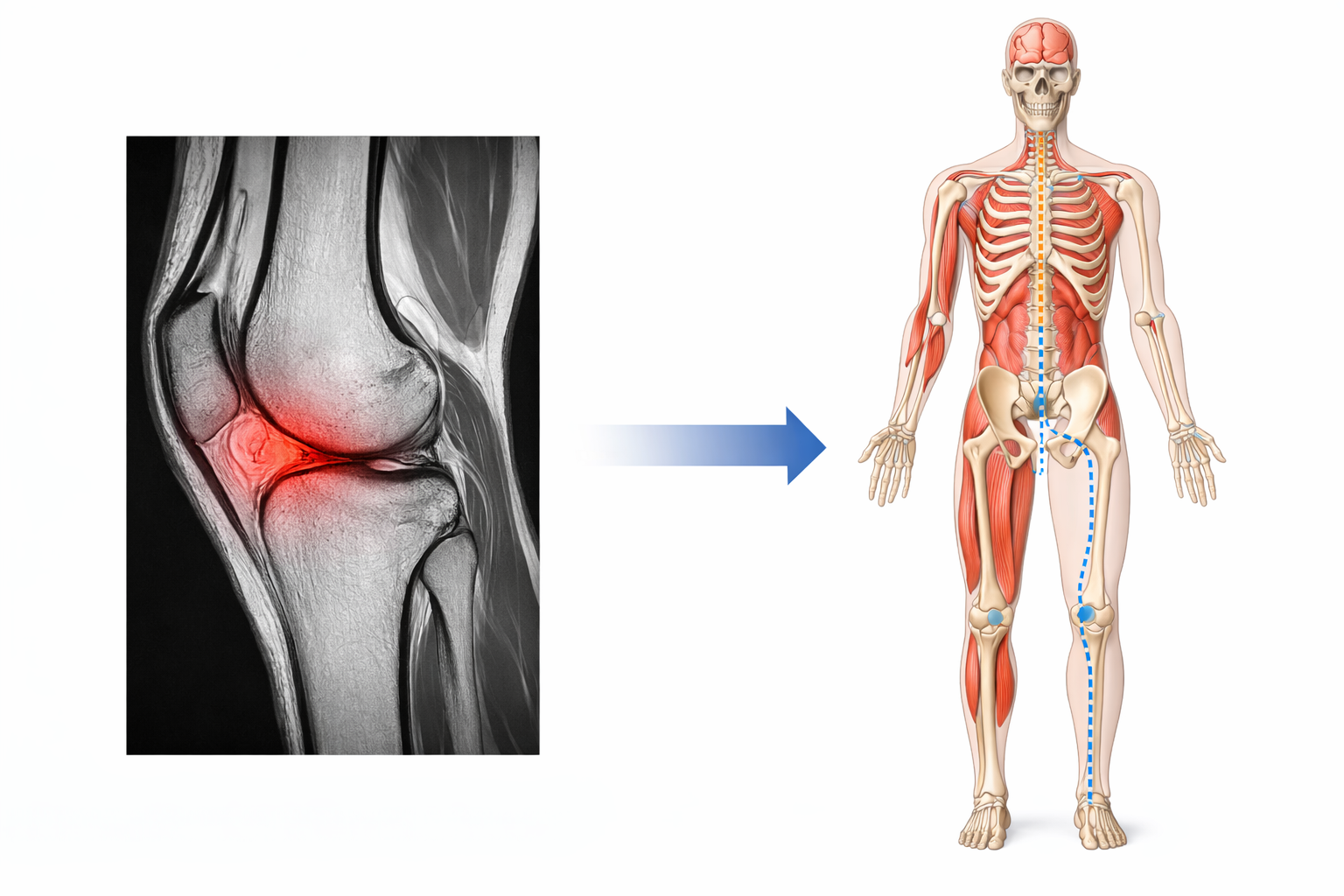
Why “Abnormal” Findings Are Often Normal
One of the most overlooked facts in musculoskeletal care is this:
Many people with no knee pain at all have “abnormal” findings on imaging.
Studies consistently show:
Meniscus changes in pain-free knees
Arthritic changes without symptoms
Structural findings that don’t match the pain pattern
This creates a problem.
If the image becomes the explanation, the body stops being evaluated as a system.
Knee Pain Is Often a Coordination Issue
The knee lives in the middle of a moving chain.
If motion is altered:
In the hip
In the pelvis
In the low back
Or in the way the nervous system coordinates movement
The knee often becomes the pressure point where stress shows up.
This is why two people with the same MRI findings can have completely different experiences:
One feels fine
The other struggles to walk
The difference is not the picture — it’s the organization of the system.
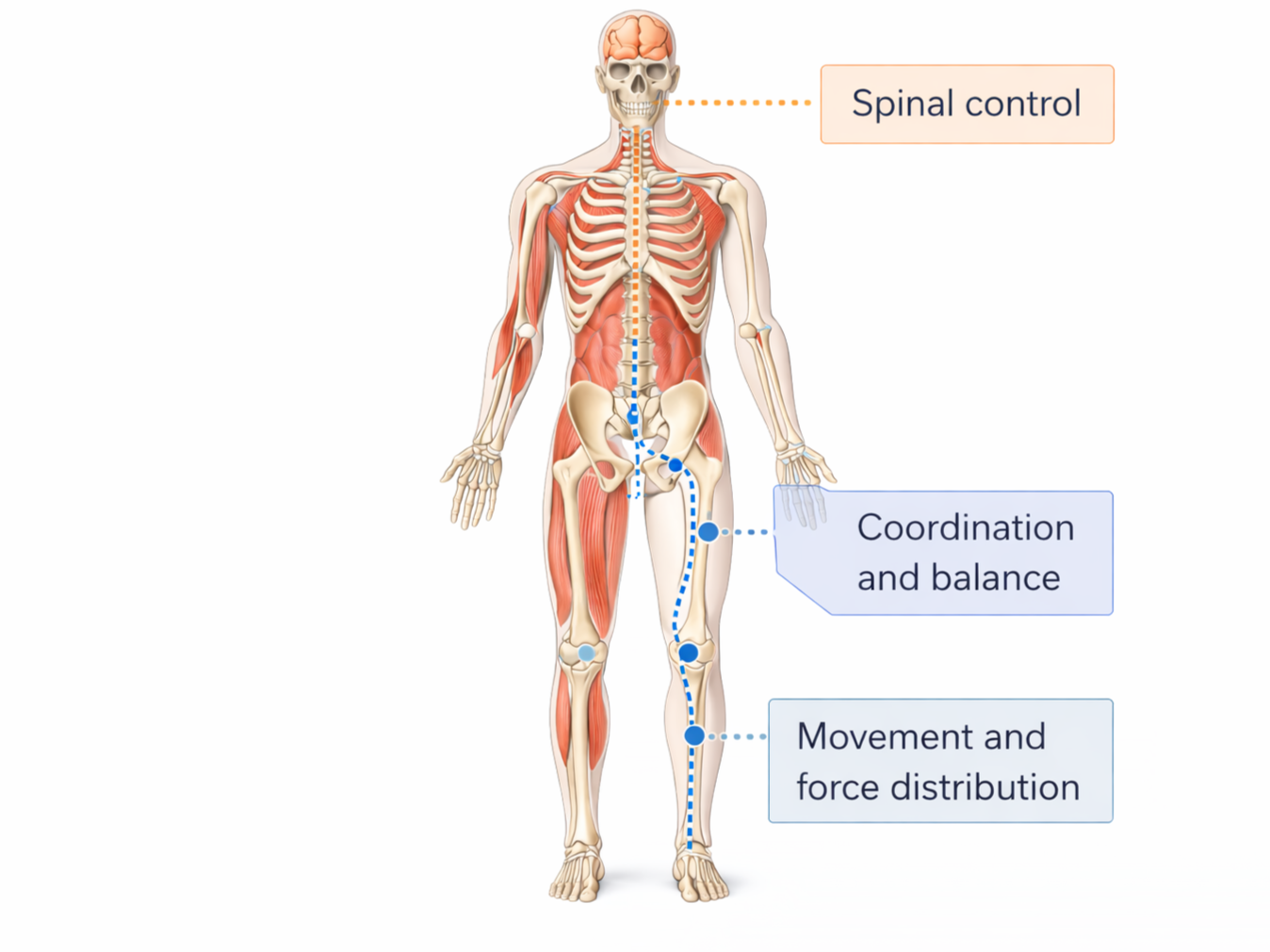
The nervous system coordinates the entire kinetic chain, linking the brain, spine, hips, knees, and feet into one adaptive system. When coordination or signal clarity is disrupted upstream, the knee often absorbs stress it was never designed to handle—resulting in pain without local damage.
When the Brain Chooses Protection Over Efficiency
Pain is not always a sign of damage.
Sometimes, it’s a sign that the brain has decided:
“This area needs protection.”
When coordination is lost elsewhere, the nervous system increases tone and guarding around the knee to stabilize movement. Over time, that protective strategy becomes uncomfortable — even painful.
Imaging doesn’t show this.
But the body feels it every step.
A Better Question Than “What Does the MRI Say?”
Instead of asking:
“What’s wrong with my knee?”
A more useful question is:
“Why is my body relying on my knee to compensate?”
When that question is addressed — by improving communication, balance, and coordination — the knee often no longer needs to signal distress.
Final Thought
Images show structure.
Pain reflects function.
Understanding the difference can be the turning point between chasing labels and actually resolving the problem.
Absolutely — here’s a short, warm, and inviting closing that fits your tone and gently opens the door to next-step curiosity without overpromising:
A New Way to Look at Knee Pain
If imaging hasn’t given you clear answers, it doesn’t mean nothing is wrong — it may simply mean the problem is being viewed through too narrow a lens.
Newer technologies and approaches now allow us to assess how the nervous system, movement patterns, and full-body coordination contribute to joint stress — often revealing answers that traditional imaging alone cannot.
If you’re curious about a more comprehensive, systems-based way to understand knee pain, we’d be happy to help you explore what’s possible.
Because sometimes the most important signals aren’t found on the image — they’re found in how the body communicates.